
Skip to content

Where everything is.

One book your family can open without a password.

Accounts, policies, the people to call, where the key is, what you would want. Written down once, kept in a drawer, read once a year.
Or fill in page one, free

The list

The things only one person in the house knows.

Most houses run on a list like this, and it lives in one head. The book is that list, written down, in an order the other person could follow on a bad day.

  • The login for the electric bill.
  • Which of the two keys opens the shed.
  • Whether the car is paid off.
  • The plumber who does not overcharge.
  • Where the title to the house is, and whether it is the original.
  • The dentist's number, and which child is due.
  • The password to the phone that holds all the other passwords.
  • Which subscriptions renew in March.
  • The vet, the dog's medication, and how much.
  • What you would want read, and what you would rather they did not.

Twelve sections

One section an evening. None of them has to be finished.

The book is laid out so a section can be done in the time it takes to find the papers. People to call is ten minutes. Money is longer, because money always is.

Nothing has to be complete for the book to be useful. A half filled book is worth far more than an empty drawer, and the yearly page is there for what you did not get to.

The First Week

The front of the book is not for you.

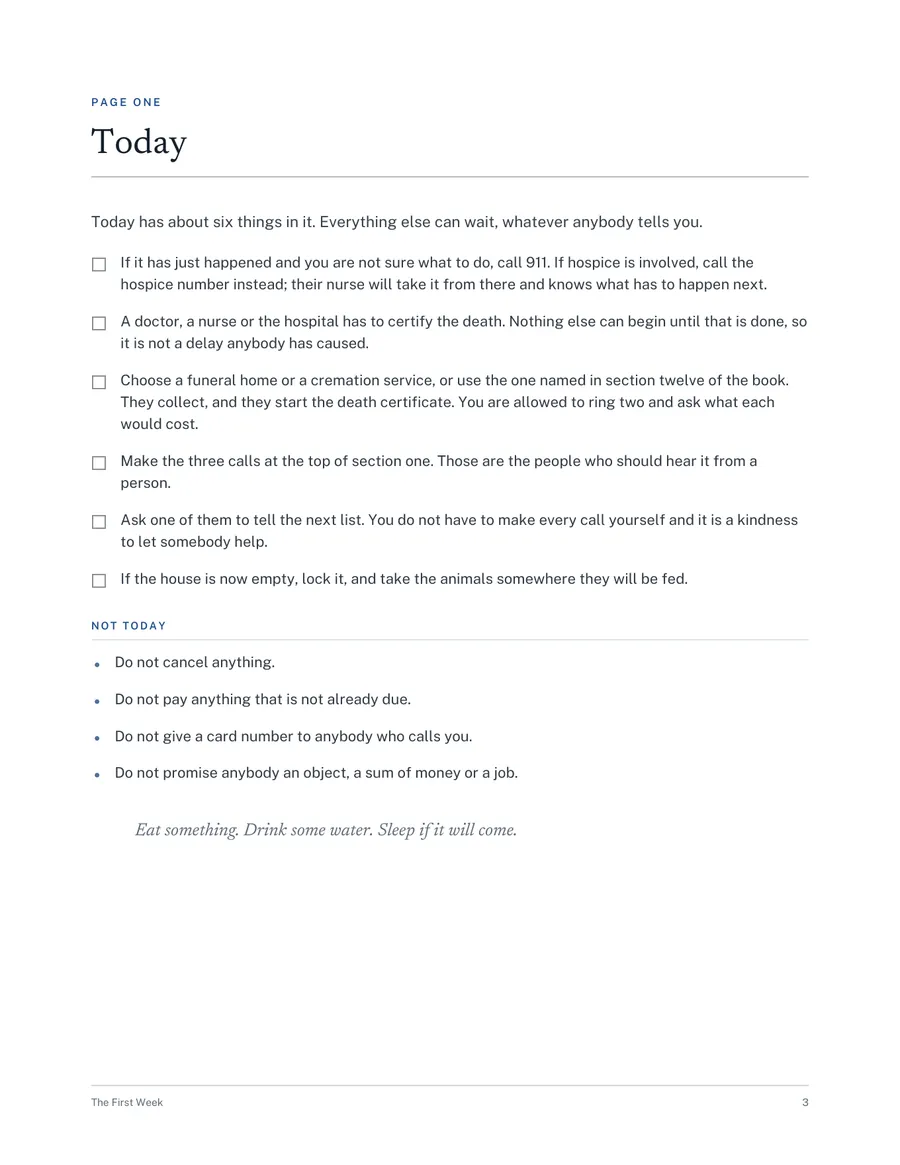
It is seven pages for the person who picks it up, in the order they will need them: what to do today, who to call this week, what can wait a month, and what nobody has to do at all.

Every page of the book is written with that reader in mind. Not what is easiest for you to fill in, but what they would need first.

Two editions

Type it in, or write it by hand. Both arrive.

The screen edition has fields you fill on a computer or tablet and save. The print edition is the same pages laid out for a pen. Both print on ordinary us letter paper.

Nothing you type leaves your machine. There is no account and no app, and the only thing we ever hold is the email address you bought with.

What is inside

Twelve sections, in the order they are bound.

The First Week sits before section one. The yearly hour sits after section twelve. Everything in between is the house.

  1. 01

    People to call

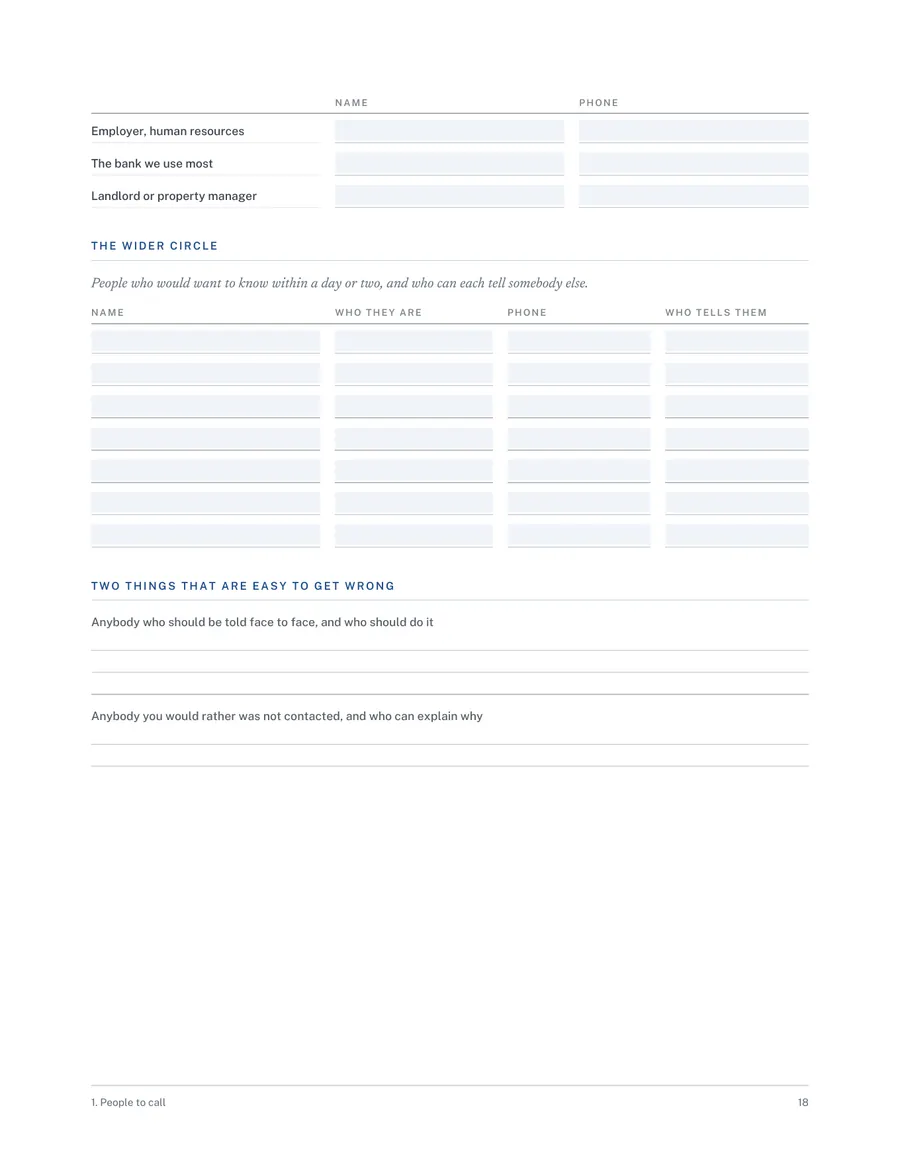
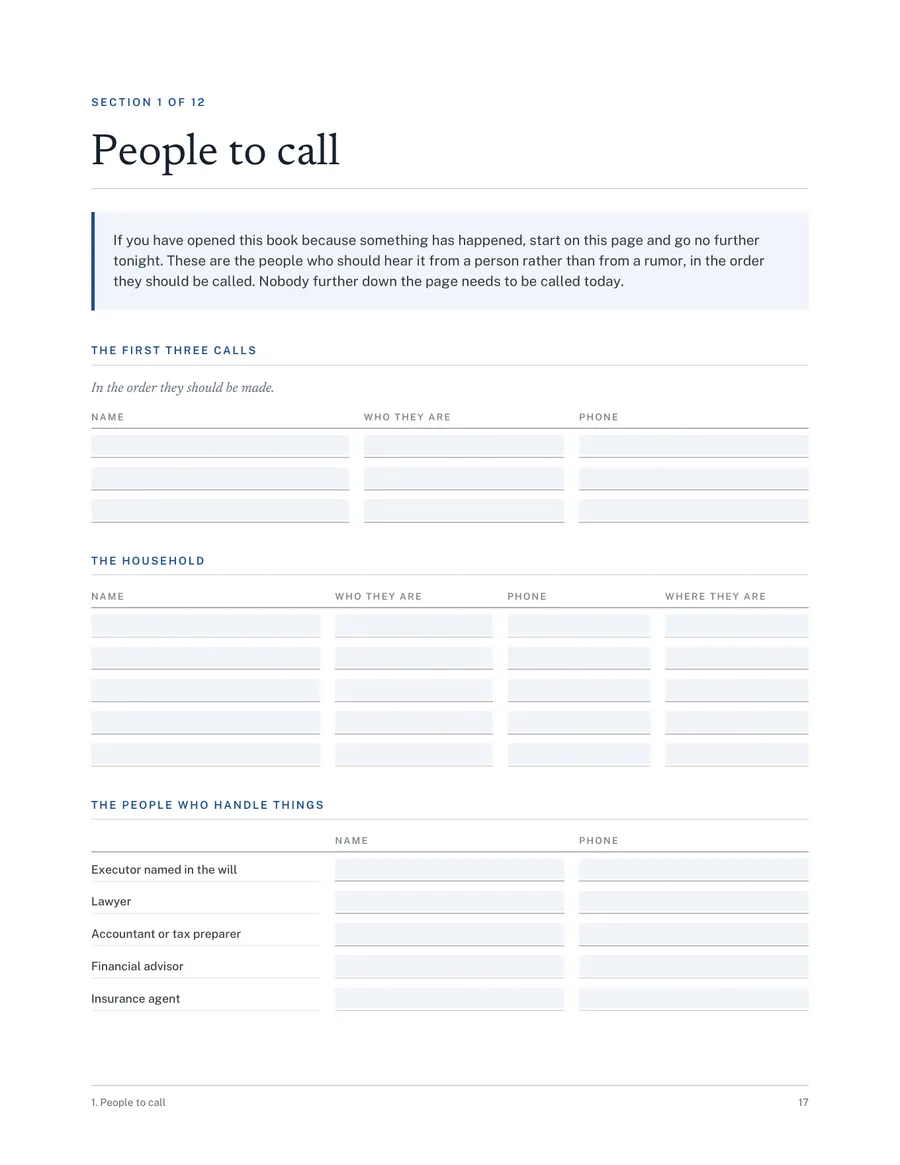
    Who to call in the first hour, the first day and the first week, with the numbers beside the names.

  2. 02

    Where things are

    The will, the deeds, the titles, the passports, the birth certificates, the spare key, the safe and its combination.

  3. 03

    Money

    Every account, what comes in, what goes out on its own, and every loan.

  4. 04

    Insurance

    Life, home, auto and health, with the policy numbers and the number to quote them to.

  5. 05

    The house

    Utilities, the furnace, the water shutoff, the alarm code, and who fixes what.

  6. 06

    Vehicles

    Titles, loans, registration, and where the second key is.

  7. 07

    Work and benefits

    Employer, retirement accounts, pensions, Social Security, and veterans' benefits.

  8. 08

    Medical

    Doctors, medications, allergies, and where the advance directive and the health care proxy are.

  9. 09

    Digital life

    Phones, email, the password manager, and what you want done with each account.

  10. 10

    Subscriptions

    Everything that renews on its own, and how to stop each one.

  11. 11

    Dependents and pets

    Who collects the children, who feeds the dog, the vet, and the medication.

  12. 12

    Wishes and letters

    The service, burial or cremation, what you would rather they did not do, and pages left blank for letters.

What it is not.

It is not a will, it is not a lawyer, and it is not a place online where your life is kept for you. Those are the three things people most often think they are buying, so they are the three things the book says first.

It is not legal advice.

It does not make a will, a trust, a power of attorney or an advance directive, and it does not tell you what yours should say. It records where they are and who holds them, and for the rest it points you to a lawyer licensed in your state.

We never see what you write.

Nothing typed into the book leaves your computer. There is no account, no cloud, no app, and nothing of yours on our servers to be breached. The only thing we hold is the email address you bought with.

It is written for the person who opens it.

Every section starts with what they would need first, not with what is easiest for you to fill in. The First Week at the front is addressed to them by name, if you choose to write one in.

What arrives

Four files land in your inbox the moment you pay.

The Household Book

$34

The screen edition

Fields you fill on a computer or tablet, then save and print.
The print edition

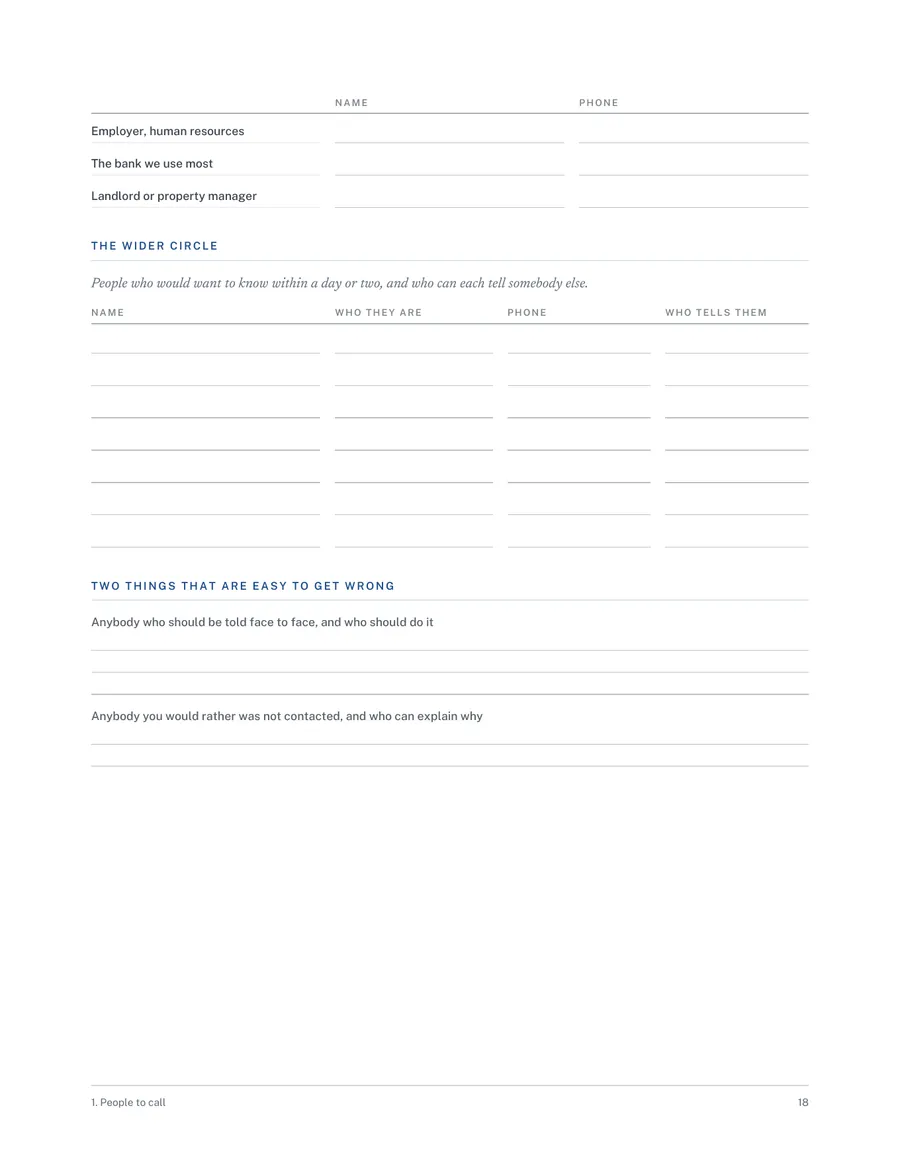
The same pages, laid out for a pen. Letter size.
The First Week

Seven pages for the person who opens it, in order.

The yearly hour

One dated page. An hour a year keeps the book true.

The nine things people ask.

No. A will is a legal document you make with a lawyer, or with a service licensed in your state. This book records where your will is, who the executor is, and everything the will does not cover: the login for the electric bill, the vet, the gate code, what you would want played. Nothing in it is legal advice, and it says so on the page.
In the file on your own computer, and on the paper you print. We never see a word of it. Nothing you type is sent anywhere, there is no account and no app. The only thing we hold is the email address you bought with, and it is printed in the footer of every page so the file is plainly yours.
Both editions arrive together. The screen edition is a PDF with fields you fill on a computer or tablet, save and print. The print edition is the same pages laid out for a pen. Many households do both: type the accounts, hand write the letters.
It is laid out in twelve sections so that one can be finished in an evening. People to call takes about ten minutes. Money takes the longest, because it means finding things. Nothing has to be complete for the book to be useful. A half filled book is worth far more than an empty drawer.
Yes. Letter size paper, dollars, and the accounts and benefits American households actually have: Social Security, 401(k)s and IRAs, Medicare, the county recorder. Where something differs by state, the page says to check yours rather than guessing for you.
Whoever you tell. Most people show their spouse or an adult child where it is and leave it at that. The First Week at the front is written for that person: what to do today, who to call this week, what can wait a month, and what nobody has to do at all.
Yes. One purchase covers one household, on as many of your own devices as you like, printed as many times as you like. A copy for a parent's house is a second household and a second book, and we would rather say so than pretend otherwise.
No. You buy it once and the files are yours. The yearly page at the back is a reminder to sit with the book once a year, not a renewal.
Write to us within thirty days and we refund you. We may ask what was missing, so that the next edition is better, but the refund does not depend on the answer.